

September was the month physical AI started to get, well, physical! The gloves are off and the checkbooks are open. Nvidia agreed to pay nearly $13 billion for Hugging Face, Qualcomm moved to acquire the steward of a foundational open-source robotics framework, and DoorDash combined a $300 million campus acquisition with a $125 million investment in Wonder. The hardware still matters, but control over models, developer tools, distribution and deployment environments is becoming the real prize.
We also went inside Wonder’s new Infinite Makeline, speaking with Spyce co-founder Kale Rogers about what it takes to make kitchen robotics work across six restaurant concepts. And if you’re in Texas, join us October 14 for the Urban Autonomy Summit Austin, presented by Empiric Earth.
Campus Delivery Becomes Big Business
With summer over, students and robots are headed back to class. After Starship shifted its U.S. focus away from the seasonal university market, Avride added 21 of its former campuses to the four it already served. Ohio State’s 125 Avride robots completed nearly 235,000 deliveries during the last academic year, according to Axios.
Robot.com and Grubhub also added ten campuses, bringing that partnership to more than 20 active deployments and extending their agreement for another three years. Campuses may empty out during summer and holiday breaks, but they give robotics companies relatively controlled environments filled with digitally native customers who already order through university dining systems. Turns out college students are pretty tolerant beta testers—as long as the robot brings snacks.
Then came the real shakeup: DoorDash agreed to pay Wonder $300 million for Grubhub Campus Dining, while investing another $125 million in Wonder itself. The campus business, born out of Grubhub’s $152M purchase of Tapingo in 2018, is integrated with university meal plans and point-of-sale systems at more than 450 colleges and universities. DoorDash plans to continue expanding across higher education before taking the technology into stadiums, hotels and other closed environments.
Delivery Robotics, Drones & AVs
Tesla’s steering wheel-free Cybercab made a surprisingly quiet, invitation-only commercial debut in Austin, accompanied by a new tutorial video. The silence didn’t last long: NHTSA opened an Audit Query the following day to examine how Tesla certified a vehicle without conventional human controls as compliant with existing federal safety standards.
Waymo rides are now available through Lyft in Nashville, making Music City the first market where the same Waymo fleet can be booked through both companies’ apps. Lyft riders requesting several standard ride types can be matched with a Waymo at no added charge, although they can decline the autonomous vehicle and request a human driver instead.
Zoox expanded testing to Houston and San Diego, initially using retrofitted SUVs with safety drivers to map roads and collect data. Houston becomes Zoox’s 12th U.S. testing market, adding sprawling service roads, aggressive merging, heavy rain and potential flooding to the company’s AV curriculum.
May Mobility and NTT Mobility are preparing the first public-road operation of an autonomous Toyota e-Palette in Japan. The companies plan multiple 2026 deployments while working toward Level 4 certification. Two weeks later, May announced plans to go public through a SPAC merger valuing it at approximately $1.4 billion and potentially delivering up to $337 million in gross proceeds.
Beep closed a Mobileye-led Series B, bringing its total capital raised to approximately $130 million. Later in the month, invited passengers began taking autonomous ID. Buzz rides through the Beep app in Lake Nona, Florida—the first U.S. passenger operation for MOIA America.
Flytrex unveiled The Dock, an unpowered rooftop platform that lets drones pre-position themselves at restaurants before orders arrive. A drone lands, shuts off its motors and later lowers a hook that restaurant staff can load without touching the aircraft. Combined with predictive fleet positioning, Flytrex claims the system can cut delivery costs by 60% and customer wait times in half; initial installations are live around Dallas-Fort Worth, with more than 100 additional sites underway.
Zipline is reportedly in talks to raise $1 billion at a roughly $20 billion valuation. If completed, the round would nearly triple the drone-delivery company’s valuation from its previous financing. Emphasis on “if completed”—this one remains a funding discussion, not a closed round.
Amazon’s rapidly expanding Prime Air network encountered a very physical scalability problem: neighbors. Residents near the company’s Richardson, Texas facility told The New York Times that frequent flights from Amazon’s 83-pound drones were disrupting life outdoors; one resident counted 52 overflights on what he considered a relatively slow day. The drone-delivery end state may be autonomous, but community relations remain stubbornly human.
Waymo updated its Safety Impact dashboard after reaching 271.3 million rider-only miles through June. Compared with adjusted human benchmarks in its operating areas, Waymo reports 95% fewer serious-injury-or-worse crashes, 82% fewer injury-causing crashes and an estimated 841 avoided injuries. Those are Waymo’s own comparisons and methodology—but few AV developers publish anything remotely as detailed.
Glendale, California approved a one-year delivery-robot pilot after months of debate over sidewalk obstruction, breakdown response times and pedestrian safety. Two operators can deploy up to 30 devices each under separate operating agreements.
DoorDash wants to make ordering fade into the background. A new text-ordering beta lets customers ask for a meal, get recommendations, build a cart and check out without opening the app. Meanwhile, DoorDash Air will test the company’s own delivery drone with Northern California restaurants, even as DoorDash continues working with Wing and Flytrex. The larger ambition is a single platform that can decide whether dinner should arrive by Dasher, sidewalk robot or aircraft. Modern Delivery has the full rundown.
Humanoids & Physical AI
Nvidia agreed to acquire Hugging Face for exactly $12.93 billion. Nvidia says the model-and-dataset hub—which serves more than 18 million developers and hosts three million models—will remain open and hardware-agnostic. That promise will get plenty of scrutiny now that the industry’s dominant chip supplier owns one of AI’s most important distribution platforms.
Qualcomm plans to acquire PickNik Robotics, longtime steward of the widely used MoveIt robotic-manipulation framework. Qualcomm says MoveIt will remain open-source and hardware-agnostic while gaining tighter integration with its Dragonwing and Arduino platforms. Apparently buying the connective tissue is in fashion.
Figure introduced Helix 2.5, demonstrating humanoids tidying rooms, folding towels and making beds across 30 homes where no training data had been collected. Figure says pretraining on its Index dataset lifted zero-shot success from 9% to 56%; Index is now ingesting roughly 35 minutes of human-behavior data every second, backed by a $3.5 billion compute commitment.
Lyte raised a Maverick Silicon-led $165 million Series C at a $1.6 billion post-money valuation. Founded by former Apple and PrimeSense engineers, the company builds custom silicon, multimodal sensors and spatial software intended to give robots a synchronized view of position and motion. Total funding now stands at $272 million.
Maven Robotics launched with a $100 million Series A. The company is developing general-purpose systems for material handling and assembly, with an ambitious target of logging one million hours of autonomous real-world operation.
Italian cybersecurity company Exein raised $270 million at a $1.7 billion valuation. Exein embeds security into the firmware of robots, drones, vehicles and other connected machines; it says its network now spans two billion devices and encounters roughly 5,000 new, non-repetitive attacks each week.
European defense-drone company TEKEVER closed the first portion of a $580 million Series D at a $6.4 billion valuation. Its systems have accumulated more than 50,000 operational flight hours in Ukraine, while the company recently secured a British Army surveillance contract worth up to £400 million.
China’s humanoid boom is beginning to meet a more skeptical public market. Regulators reportedly signaled a higher bar for robotics listings after Unitree’s spectacular debut gave way to a roughly 50% fall from its post-listing peak. For a deeper look at the founder who built the company, ChinaTalk profiled Unitree CEO Wang Xingxing.
Mistral AI’s robotics chief is reportedly seeking €200 million for a new startup that would train robotics models on a broader data foundation. That is an eye-popping target for a company that, at least publicly, barely exists yet.
Destro AI emerged from stealth with an $8 million seed round. Rather than building another robot, Destro is developing an operating layer that assigns tasks across robots and human workers. Its first Yusen Logistics pilot uses three Miva Robotics cart movers coordinated by Destro’s Vision and Mothership systems.
Back of House Automation
Wonder debuted its Infinite Makeline, an automated assembly system that can produce up to 500 bowls per hour using 68 ingredients, with average order-to-ready times under three minutes. The first installation supports six restaurant concepts from one line at Wonder’s Midtown East location, with dozens more deployments planned. We spoke with Spyce co-founder Kale Rogers about what the system had to relearn after moving beyond Sweetgreen’s comparatively focused menu.
Burger King is making it easier for drive-thru customers to reach a human after discovering that forcing guests to order through voice AI can lead to drive-offs. The company remains interested in automation, but its evolving drive-thru strategy is a helpful reminder that completion rates don’t matter much if frustrated customers leave the line.
Presto raised $10 million from Remus Capital-affiliated and existing investors to expand its drive-thru voice platform. The company recently joined Toast’s partner ecosystem and works with ElevenLabs, whose own valuation doubled to $22 billion through a $300 million employee tender.
Kiosks, Retail & Self-Checkout
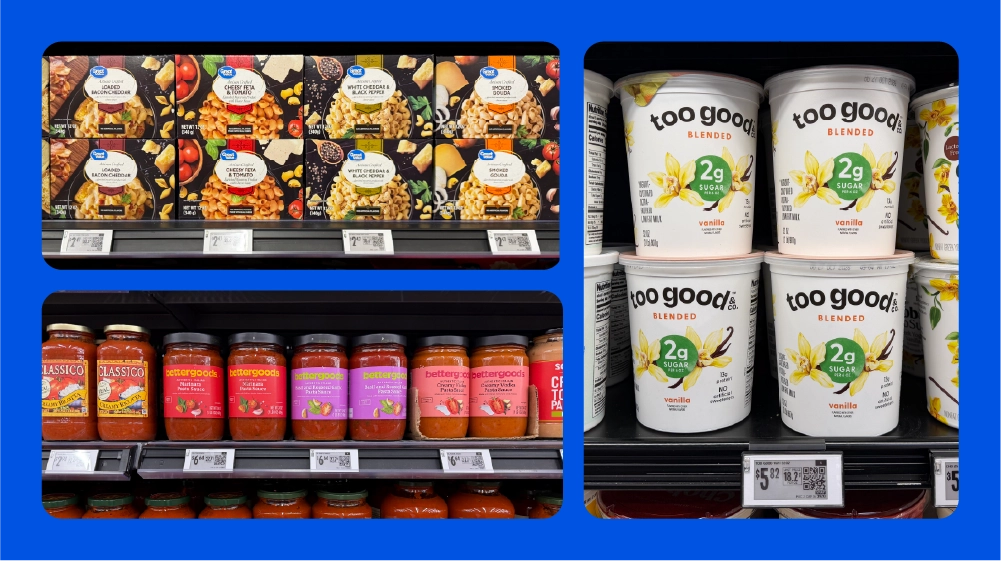
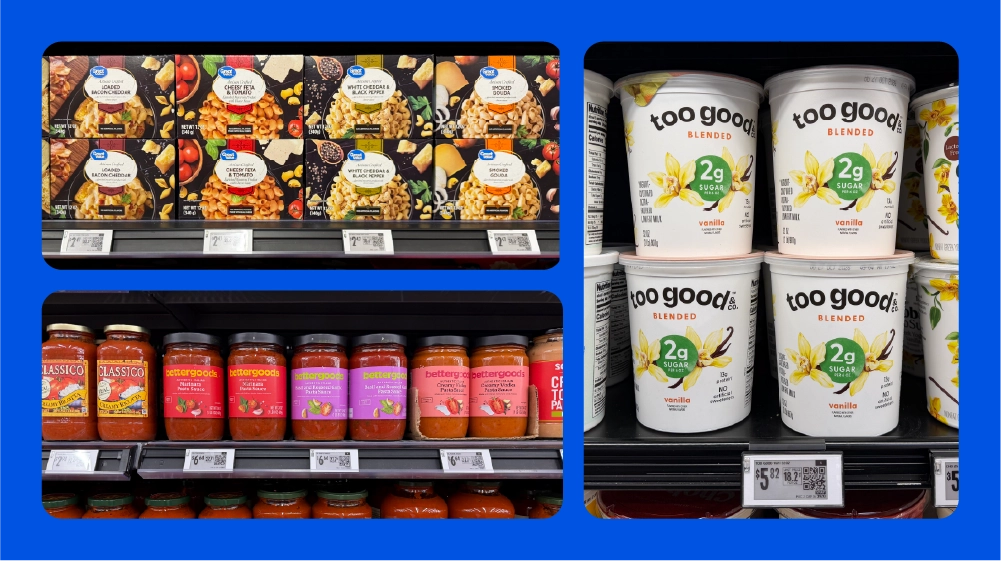
Electronic shelf labels are drawing organized labor scrutiny. An AFL-CIO Tech Institute report estimates that universal U.S. grocery adoption could affect between 44,223 and 191,633 jobs and eliminate $1.6 billion to $6.9 billion in annual wages. The group argues that the same infrastructure could also enable rapid algorithmic or surveillance-based pricing, and is calling for a ban.
Walmart introduced Shop to Light, allowing shoppers to illuminate the LED on a digital shelf label when searching for an item, integrated with the Walmart app.
Industry Trends
Eatable Adventures is targeting a €50 million second fund dedicated to Italian agrifood-tech startups, with a first close expected before year-end. The Madrid-based accelerator says Italian institutional investors, corporations, family offices and traditional VCs are showing growing appetite for the category.
In Other News
Deliveroo and Coco Robotics also announced an exclusive UK partnership, beginning in London’s Canary Wharf. Saudi startup Nero began operating autonomous delivery vehicles in Riyadh’s Al-Falah district. Aurora plans to operate more than 30,000 driverless trucks by 2030. Kodiak named IKEA as the launch customer for its driverless long-haul service.
Urban Autonomy Summit — Austin

Next week, we gather in Austin, Texas for the latest edition of the Urban Autonomy Summit. Join autonomy leaders from Avride, MOIA, PlusAI and Autolane, plus investors, regulators, media and many more. Apply to attend now — only a few spots remain!