

Automation may look great in a spreadsheet or work perfectly in your model, but things start to get tricky when humans — especially the ones that vote — can weigh in on the impact. Throughout October, we saw a bevy of new policies and regulations, from local to federal, starting to materially impact robotic operators.
Philadelphia proposed charging robots for the human wages they displace. San Jose adopted a permitting regime for sidewalk machines. Chicago plaintiffs sued over alleged biometric-data collection. In San Diego, human drivers found themselves waiting behind fleets of Waymos at public chargers.
Even Washington joined in, declaring reliance on imported robotics and industrial machinery a national-security threat. The robots aren’t just products anymore; they’re infrastructure, industrial policy and, increasingly, political targets.
None of this appears to be slowing the money. Robotics startups raised $9.9 billion globally in the third quarter. Waymo reportedly wants to grow from roughly 4,000 vehicles to 20,000 next year. Let’s dig in!
Partner | Platform fee rate fell 17.6% in AV cities, while rising 6.9% nationwide

Robotaxis may be impacting traditional rideshare fleets in markets where they have launched. In the five U.S. cities where robotaxis have run the longest, Uber and Lyft are keeping a smaller share of each fare, while their share keeps growing everywhere else.
Our findings include:
Median platform fee rates fell 17.6% in the five AV cities and fell in every one of them. In the rest of the country, they rose 6.9%.
Drivers in AV cities completed 3.1% fewer trips per hour, more than double the 1.2% drop in the rest of the country.
Driver base pay per hour grew just 3.2% in AV cities, trailing the 5.4% rise in the rest of the country.
In San Francisco, the platform’s cut of each fare fell from 19.0% to 10.2% while customer prices did not increase at all, while they rose 11.7% in the rest of the country.
Download the full report to see what changed for drivers in each AV city.
Delivery Robotics, Drones & AVs
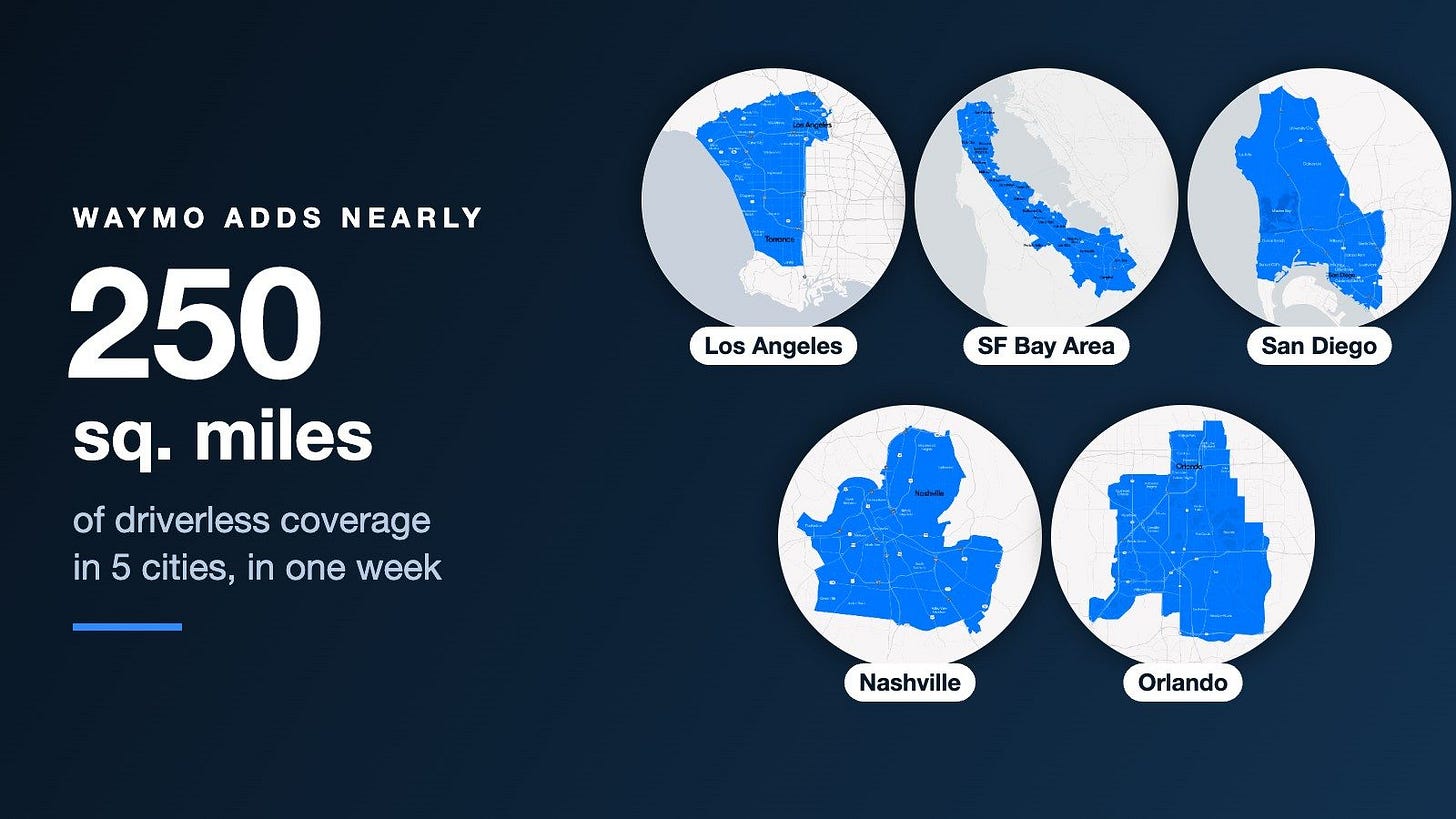
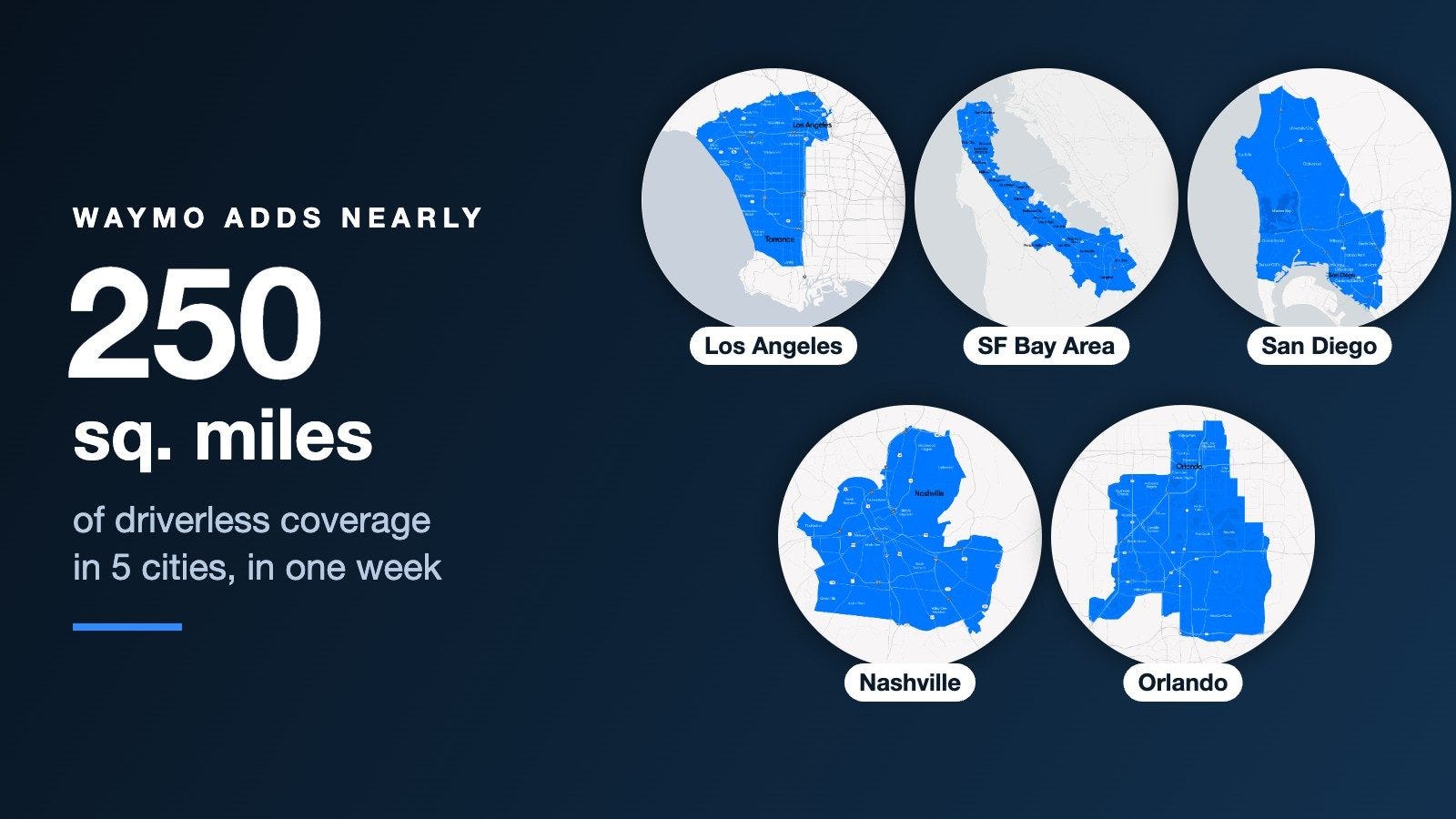
Waymo is preparing for an extraordinary fleet expansion. The company reportedly plans to grow from roughly 4,000 vehicles today to 8,000 by year-end and 20,000 by the end of 2027, supported by its first-ever $5 billion debt financing. It also added nearly 250 square miles of service territory across Los Angeles, Nashville, Orlando, San Diego and the Bay Area. Robotaxis have officially entered their infrastructure era.
Philadelphia City Council proposed an “Automated Services Displacement Tax” aimed explicitly at services once performed by people. The bill would charge autonomous deliveries the greater of 5% of gross receipts or 50 cents per delivery, robotaxi rides the greater of 5% or $1 per trip, and autonomous freight services 3% of applicable revenue. Proceeds would support the city’s zero-fare transit program. It remains a proposal, but it may be the clearest attempt yet to put a price on automation’s alleged displacement of human labor.
San Jose adopted permits, operating rules and escalating fines for delivery robots. Operators will pay $200 annually for each sidewalk device and $250 for roadway devices; sidewalk speeds are capped at 5 mph; and disabled robots must be removed within 30 minutes. Violations rise from $100 to $500. Coco and Serve already operate in the city, so this is less a hypothetical framework than a bill coming due.
Two proposed class actions accuse Coco and Serve of violating Illinois’ biometric privacy law by collecting facial or other biometric data as their robots traveled through Chicago. Both companies deny that their systems identify people or create biometric profiles. The cases could help determine whether a robot merely seeing a pedestrian is legally different from recognizing one.
Avride expanded on two fronts. It signed an agreement with Sodexo Campus to accelerate deployments across Sodexo’s approximately 425 higher-education partners, promising to move campuses from interest to implementation in weeks. Separately, Wonder expanded its Avride deployment across Jersey City, Hoboken, Arlington County and Philadelphia. Wonder says robots already handle nearly 20% of deliveries from its Jersey City location.
Serve and DoorDash launched Australia’s first commercial sidewalk delivery-robot service in the Gold Coast Health and Knowledge Precinct. The deployment is Serve’s first market outside the United States, with a Griffith University facility supporting local operations.
Britain’s robotaxi field is getting crowded. Uber, Pony.ai and Verne plan to test Pony.ai’s seventh-generation robotaxi in Manchester, initially with safety drivers. In London, Baidu’s Apollo Go and Lyft-owned Freenow demonstrated the RT6 robotaxi and are targeting fully driverless service in 2027. The U.K. rollout may have slipped, but the jockeying has not.
Waymo and Toyota plan to build and test autonomous Toyota bZ4Xs in Japan during 2027, followed by the U.K. and other Waymo markets. Toyota’s Takaoka plant will integrate Waymo hardware during vehicle production—an important step away from small-batch retrofits and toward factory-built autonomous fleets.
Hertz spun its autonomous-fleet operation into a standalone company called Oro Mobility, which raised $80 million from investors including Steve Cohen’s family office. Hertz will retain a majority stake, while Oro sells cleaning, charging, maintenance and fleet-management services to robotaxi operators. The picks-and-shovels business of autonomy now includes washing the picks and charging the shovels.
Rivian acquired U.K. world-model startup Third Dimension to accelerate development of its driver-assistance and planned robotaxi systems. Third Dimension turns video and images into realistic 3D environments, giving Rivian more synthetic worlds in which to train before putting vehicles into the decidedly less synthetic real world.
Walmart and Wing began drone delivery from seven stores around Charlotte, with two more planned. Meanwhile, Zipline announced software that dynamically adjusts flight behavior using local acoustic conditions, claiming 68% lower cumulative sound exposure and 24% lower peak volume than its 2025 fleet.
Einride will evaluate Nvidia’s Alpamayo reasoning model in its autonomous trucks, initially in shadow mode, with live-road evaluation planned for the second half of 2027. The language model will be allowed to reason about unusual road situations; Einride’s existing safety system will retain control.
Humanoids & Physical AI
RobCo crossed a $1 billion valuation through a transaction combining new investment with employee share sales—doubling its valuation in nine months. Its next act is Alfie, a two-armed autonomous industrial robot slated for commercial launch in March 2027. RobCo is also expanding its U.S. footprint, with assembly in Austin and an AI lab in San Francisco.
Machenta emerged from stealth with a $40 million seed round, described as the largest ever raised by a U.K. robotics startup. The Imperial College spinout says its foundation model can teach robots—including humanoids—a new task from a single demonstration, without collecting more data or retraining the model. The company calls it “physical vibe coding,” which is either a very good shorthand or an unforgivable phrase.
Swiss startup Enact raised $30 million in pre-seed funding to build what it calls an artificial nervous system for robots. Its force-sensing actuators feed touch and pressure information directly into the robot’s AI model, targeting the fine manipulation tasks that vision alone cannot solve. Humanoids already have eyes and language; investors are now funding their sense of touch.
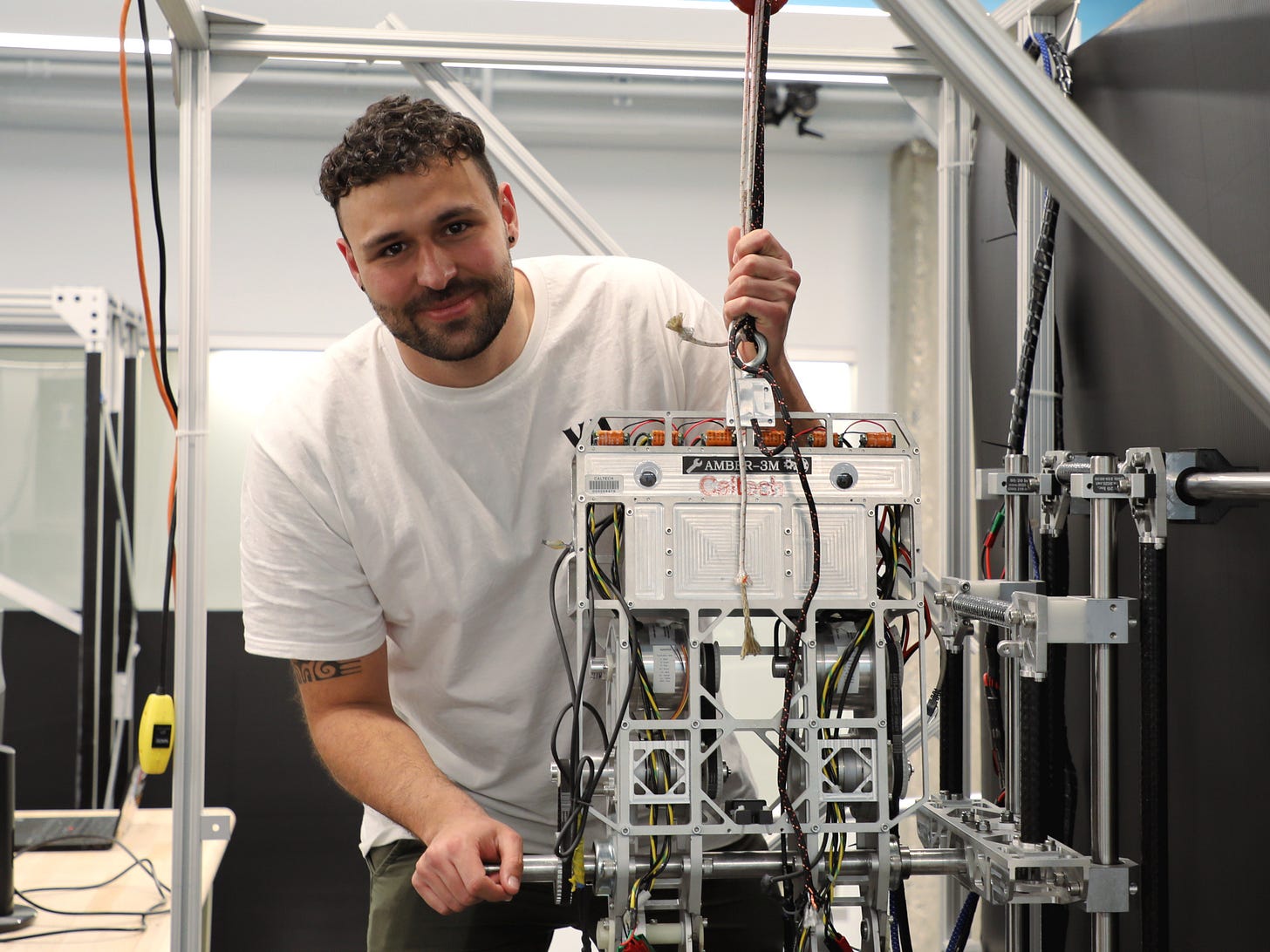
Enact / Izon Media

Fulfillment & Back of House Automation
Walmart’s decade-long, multibillion-dollar warehouse automation program is running into an old enemy: irregular objects. The Wall Street Journal reports that robots still struggle with cardboard boxes, mixed merchandise and items such as frozen turkeys, even as Walmart installs smaller mobile robots in more than a dozen facilities. Turns out the turkey remains an adversarial input.
Ricoh will provide deployment, maintenance and lifecycle support for Hyphen’s Automated Makeline, an under-counter system that assembles up to 200 bowls and salads per hour from digital, kiosk and drive-through orders. Hyphen’s investors include Chipotle and Cava; Ricoh gives it a national service network capable of supporting restaurant-scale rollouts.
Construction, Farm & Sourcing Automation
Bedrock Robotics raised a $600 million Series C at a $4.1 billion post-money valuation, bringing total funding close to $1 billion. The company retrofits construction equipment for autonomous operation and says its excavators have been performing paid, fully autonomous work since August. Heavy equipment may be physical AI’s most straightforward business case: expensive machines, controlled sites and plenty of repetitive work.
Foundry Robotics raised a $100 million Series A to build what it calls America’s first autonomous factory for complex assembly. Its new 130,000-square-foot Emeryville facility will combine robotic cells with human workers to produce drone, vehicle, telecom, satellite and defense subassemblies. The factory building robots and vehicles will itself be run by robots. We have reached recursion.
Kiosks, Retail & Self-Checkout
Kroger wants its AI shopping assistant to do more than answer questions. The grocer is measuring whether recommendations produce repeat use, completed purchases and expansion into categories customers normally buy elsewhere. At the same time, Kroger plans to eliminate roughly 3,000 corporate roles over three years as it expands AI across its operations. The productivity promise is becoming a headcount plan.
Walmart introduced Agent Profiles, an Agent Gateway and operating terms for third-party AI agents shopping on customers’ behalf. Customers can authorize individual agents and set per-purchase or overall spending limits, while agents receive the same prices offered to human shoppers. Walmart is preparing for a world in which its customers may be software—and wants those customers properly authenticated.
Industry Trends
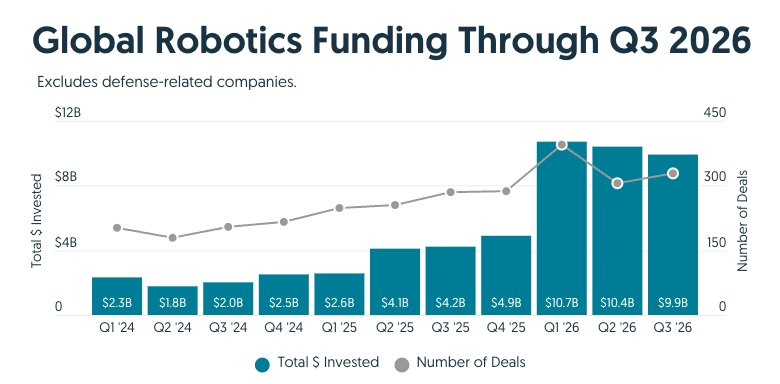
Global robotics startups raised $9.9 billion in the third quarter, up from $4.3 billion a year earlier. Funding through the first three quarters increased 185% year over year, with Chinese robotics companies raising $13.2 billion and U.S. companies $12.1 billion. Crunchbase counted 45 newly funded robotics unicorns this year alone.
California startups have raised an extraordinary $385 billion so far this year, representing more than three-quarters of U.S. startup funding. OpenAI and Anthropic account for more than half the total, but California also captured nearly $62 billion in seed and early-stage capital. Venture’s geography is becoming more concentrated, not less.
The White House declared that imports of robotics, industrial machinery and related components threaten to impair U.S. national security. The proclamation does not immediately impose tariffs; it orders negotiations with trading partners and allows tariffs, quotas, duties or fees if agreements fail. It is nonetheless a major shift: robotics policy is now trade policy, defense policy and industrial policy at once.

In Other News
Seoul’s Galaxy Robot Park is giving visitors a close-up look at dancing, entertaining and companion robots—along with a reality check on how much human assistance many still require. Dynamic Creatures introduced Hugo, a freely moving character robot with 43 actuators and a planned vision-language-expression model intended to connect perception and speech with gestures, movement and emotion. Robotis will provide 750,000 actuators for 50,000 units of Pollen Robotics’ tiny Micro Duck, after a Jensen Huang demonstration reportedly produced another 15,000 orders; never underestimate the commercial power of a very small duck. Philadelphia artist Madison Polidoro responded to delivery bots with Awebot, a remote-controlled pink potato designed to deliver surprise, curiosity and human interaction rather than food. If the sidewalks must be filled with machines, at least one of them is bringing awe. EV drivers complain that AVs are hogging all the charging ports. Which promises has Tesla kept as scales up Cybercab production? Amid tie-up with DoorDash, Instacart kills off Caper Carts.